

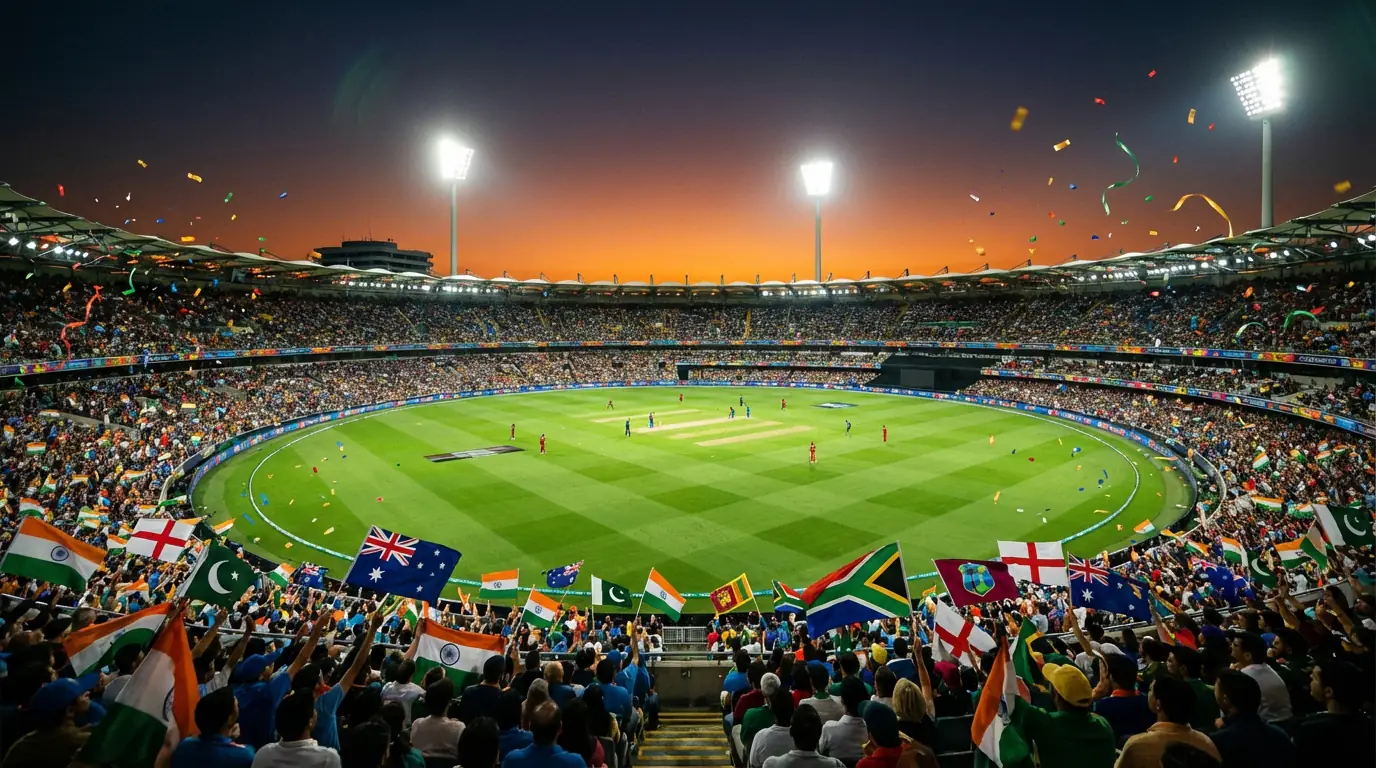
The ICC T20 World Cup is the most concentrated burst of high-stakes T20 cricket on the calendar. Over three to four weeks, the best teams in the world compete in a format that combines the chaos of T20 with the pressure of knockout tournament cricket. For bettors, it is a unique environment — one where regular-season T20 logic applies in part but where tournament-specific dynamics create patterns and opportunities that do not exist in bilateral series or franchise leagues.
What makes World Cup betting distinct is the combination of unfamiliar conditions, varied opposition, and escalating stakes. Group-stage matches between full members and associate nations produce lopsided odds that are difficult to find value in. But as the tournament progresses — into the Super 8s, semi-finals, and the final — the matches become more competitive, the pressure intensifies, and the betting markets become richer. The arc of the tournament itself is an analytical input that most bettors ignore.
This guide covers the major betting markets available during the T20 World Cup, the tournament-specific factors that influence outcomes, and the strategic approach that gives you the best chance of finishing the event in profit.
See also Big Bash League betting.
Outright Winner: The Long-Range Bet
The outright winner market — betting on which team will win the entire tournament — is the highest-profile market and the one that opens months before the first ball is bowled. It is also the market where the most money is wagered and where the bookmaker’s margin tends to be thinnest, because the high liquidity and public interest force competitive pricing.
The challenge with outright betting is that T20 cricket is inherently volatile. The best team does not always win a T20 World Cup — in fact, recent tournaments have consistently produced unexpected finalists and winners. This volatility suppresses the true probability of even the strongest favourite. A team priced at 3.50 to win the tournament might indeed be the best side on paper, but the probability of them navigating five or six high-pressure matches without a single bad day is lower than in a Test series or even an ODI World Cup, where the longer format rewards consistency.
For outright betting, the key analytical inputs are squad depth, adaptability to conditions, and tournament experience. A team with a deep batting lineup that can recover from early wickets, a versatile bowling attack that can operate in different conditions, and senior players who have performed in previous ICC events has a structural advantage in tournament cricket. These attributes are not always reflected in the pre-tournament odds, which tend to be influenced by recent bilateral form — a poor predictor of tournament performance.
The timing of your outright bet matters. Pre-tournament odds are based on squad announcements, warm-up results, and public perception. Once the tournament begins, the outright market adjusts with every match. A strong performance in the group stage shortens a team’s odds, while an early loss lengthens them. If you believe a team is a genuine contender but they suffer a minor setback in the group stage — a close loss to a strong opponent, for example — the post-loss outright price may offer better value than the pre-tournament price, because the market overweights the recent result.
Group-Stage Betting: Navigating Mismatches and Upsets
The group stage of a T20 World Cup features matches between full ICC members and associate nations — teams like Namibia, Papua New Guinea, or the Netherlands facing India, England, or Australia. These matches produce odds of 1.03 to 1.10 on the favourite, which are essentially unbettable for anyone seeking value. The margin on such short odds is prohibitive, and the potential for a shock upset — while small — is catastrophic relative to the tiny potential profit.
The value in group-stage betting comes not from the mismatches but from the competitive matches between full members. When India play South Africa or England face Australia in the group stage, the odds are tighter and the analytical framework for T20 betting applies normally. These are the group-stage matches worth your attention and your stake.
There is also a secondary group-stage market that offers consistent value: the match totals market. Group-stage matches are often played at venues that the teams are unfamiliar with, and the bookmaker’s over/under line is set based on limited data from the specific venue. If you research the venue’s characteristics — boundary dimensions, pitch history from domestic cricket, altitude, and typical weather — before the tournament begins, you may have a better baseline than the bookmaker for early-round matches. This informational advantage erodes as the tournament progresses and more data from the specific pitches becomes available, but in the first week it can be substantial.
One more group-stage consideration: net run rate. In T20 World Cups, group qualification often comes down to net run rate, which incentivises teams to win by large margins. When a strong team is chasing a modest target set by a weaker opponent, they will often chase aggressively to boost their NRR rather than coasting to a comfortable win. This aggression can push the match total higher than the line implies, creating value on the over in matches that look like blowouts on paper.
Knockout-Stage Betting: Where Pressure Changes Everything
The knockout rounds of a T20 World Cup — semi-finals and the final — are the most valuable matches for informed bettors. The odds are competitive, the markets are liquid, and the dynamic of sudden-death cricket introduces psychological factors that bilateral T20 cricket does not replicate.
Pressure in knockout matches affects teams differently. Some sides thrive on the occasion — their key players have a history of delivering in ICC knockout matches, their bowling attacks tighten under pressure, and their fielding standards rise. Other teams fold. The historical record of knockout performance is one of the most underused inputs in T20 World Cup betting. A team that has lost three consecutive ICC semi-finals carries a pattern that is not about talent — it is about how that group of players responds to the highest-pressure moments.
The toss in knockout matches gains additional significance because the conditions at that specific time of day — dew, light, wind — interact with the win-or-go-home pressure. If heavy dew is expected in the evening session of a semi-final, the team winning the toss and choosing to chase has a compounded advantage: the structural dew benefit plus the psychological benefit of knowing the target. The market adjusts for the toss, but in knockout matches, the combined effect of conditions and pressure is often larger than the sum of its parts.
One specific knockout-stage pattern is worth noting: the final tends to produce lower totals than the average group-stage match. The pressure of the occasion, combined with the fact that both teams are playing their strongest bowling attacks with nothing held in reserve, suppresses scoring. If the over/under line for the final is set based on the tournament’s average scoring rates, the under may offer value because the final’s dynamics are structurally different from a group-stage contest.
Conditions and Venue Rotation: The Adaptability Factor
T20 World Cups are hosted across multiple venues within a country or, in some editions, across multiple countries. Teams that advance through the tournament play on different surfaces, in different climates, and sometimes at different altitudes. This venue rotation is a significant factor that separates World Cup cricket from domestic T20 leagues, where teams play multiple matches at their home ground.
Adaptability becomes a critical quality in World Cup cricket. A team that relies heavily on pace bowling might dominate on bouncy Australian surfaces but struggle on slow subcontinent pitches. A team built around spin might cruise through group matches in India but find themselves outgunned in a semi-final moved to a pace-friendly venue in South Africa. Assessing each team’s ability to adapt to different conditions — rather than just their performance in their most recent series — is essential for outright and match winner betting.
The practical approach is to map each team’s squad composition against the conditions they are likely to face. If the tournament is in the Caribbean, teams with strong pace attacks and aggressive batting suit the bouncy pitches. If the tournament moves to India, spin depth becomes critical. This mapping exercise should inform your outright selection before the tournament and your match-by-match assessments as teams move between venues.
The weather patterns at World Cup venues also deserve specific attention. Tournaments in the Caribbean and South Asia often face the threat of rain, which can wash out matches and produce shared-points results in the group stage. A team that benefits from a rained-out match — by sharing points with a stronger opponent — effectively gains a free result. Monitoring weather forecasts across all venues and understanding the implications for group qualification can inform both outright and group-stage match betting.
In-Play Betting During the T20 World Cup
Live betting during World Cup matches follows the same principles as standard T20 in-play betting, but with one critical addition: the stakes amplify everything. Powerplay overreactions are larger in World Cup matches because more casual money flows into the market during high-profile events. The odds spike after an early wicket in a semi-final is more dramatic than the equivalent spike in a bilateral T20, because the emotional weight of the moment is greater.
This amplification is a double-edged sword. The overreactions are bigger, which means the value opportunities are bigger. But the reversals can also be sharper — a team that fights back from a poor powerplay in a World Cup match can see their odds swing twenty or thirty points in a single partnership. The in-play bettor in World Cup matches needs the same pre-commitment framework as in regular T20 betting but with even more discipline, because the emotional pull of the occasion makes impulsive betting more tempting.
Player performance markets during the World Cup deserve special mention. The top batsman and top bowler markets see inflated odds on lesser-known players from associate nations, creating occasional value when an associate player genuinely has the quality to compete at the top level. More commonly, though, the value in player markets during the World Cup is found in the full-member matches, where the bookmaker must set odds across large squads and where specific matchup information — which batsmen are vulnerable to which bowling types in which conditions — can give the prepared bettor an edge.
The Tournament Is the Teacher
The T20 World Cup compresses an enormous amount of cricket into a short window, and the bettor who approaches it as a learning experience — adjusting their models with each match, revising their outright assessments after each round, and tracking which patterns hold and which break — will finish the tournament smarter than they started. The best time to bet on the next T20 World Cup outright winner is often the day after the current one ends, when the lessons are fresh and the market has not yet priced in the insights that only a completed tournament can reveal.
