

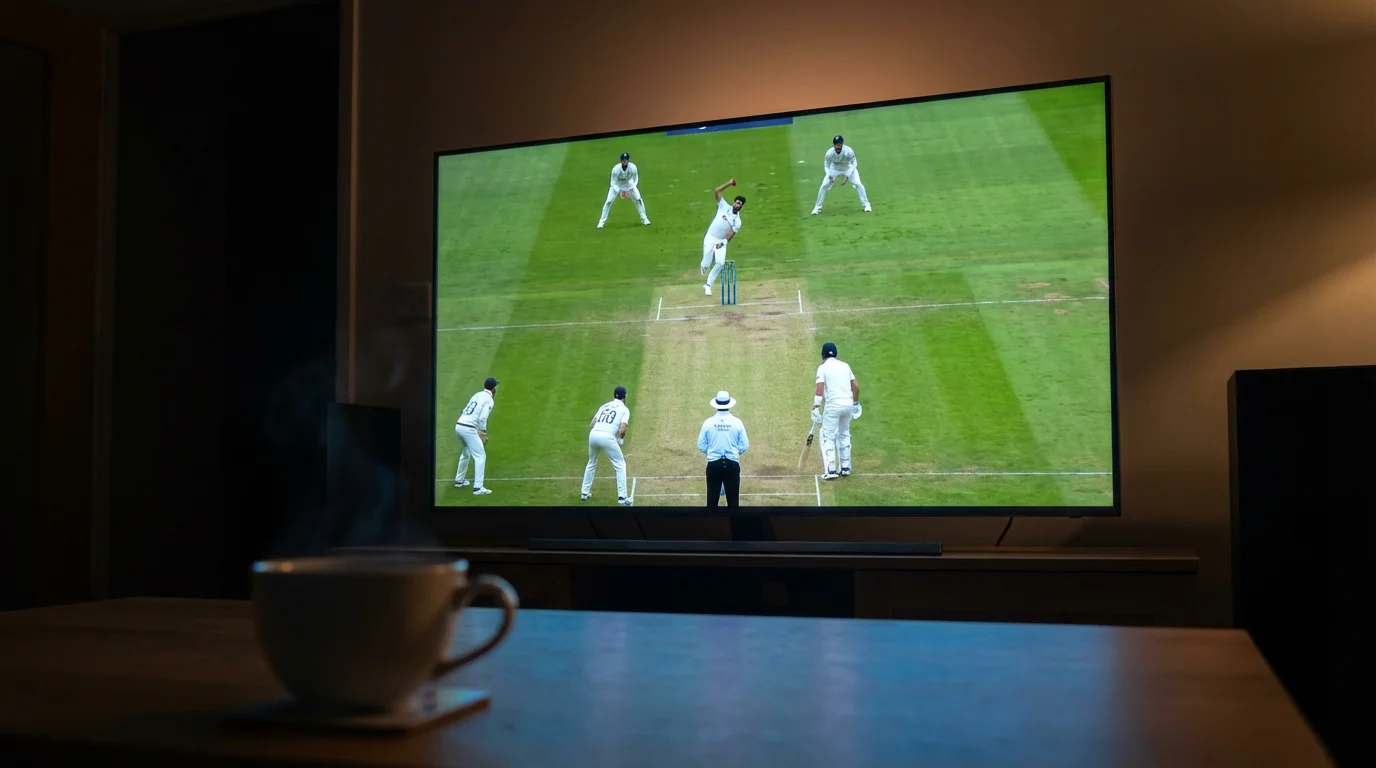
There are two kinds of live cricket bettors: those who watch the match and those who follow the scorecard. The scorecard bettor sees numbers — 85/3 after twelve overs, required rate 8.2 — and makes decisions based on that numerical snapshot. The streaming bettor sees everything the scorecard does not: the bowler’s body language after a near-miss, the batsman flinching against the short ball, the fielding captain repositioning his slips, the clouds rolling in from the west. These visual signals are information, and in live betting, information that is not yet priced into the odds is the definition of an edge.
The gap between what the scorecard shows and what the stream reveals is the fundamental reason that watching live cricket creates a betting advantage. Bookmakers’ in-play models are driven by data feeds — ball-by-ball results that record runs, wickets, and extras. They do not record the ball that beat the bat without making contact, the fielder who nearly ran out the batsman but missed by inches, or the patch of rough that the spinner is starting to target. These events do not appear in the data, but they appear on the screen — and the bettor who sees them before their consequences materialise in the scorecard has a genuine informational advantage.
This article explains how to convert live streaming into a betting edge, which visual signals matter most, and how to structure your viewing to maximise the information you extract from each match.
See also using live cricket statistics.
The Informational Advantage of Watching Live
The core mechanism is simple: visual information updates faster than statistical information. You can see a pitch misbehaving — the ball keeping low, turning sharply, or bouncing unevenly — several overs before the statistical consequences appear in the scorecard. A batsman’s discomfort against a specific bowler is visible in his footwork and shot selection long before it produces a dismissal. A bowling change that targets a known weakness is apparent the moment the captain waves the new bowler into the attack, not when the wicket eventually falls.
This speed advantage translates directly into live betting value. If you can see that the pitch is deteriorating and the ball is starting to misbehave, you can take a position in the under on runs or the over on wickets before the market adjusts. The market will adjust — once wickets fall or scoring rates drop, the data feed will trigger model updates and the odds will move. But by then, the value has gone. The stream gives you a preview of what the data will eventually confirm, and that preview is your window to act.
The informational advantage is not limited to pitch and batting observations. Field placement changes are visible on the stream and often signal tactical intent before the tactics produce results. When a captain posts a short leg and a silly point to a specific batsman, he is telling you — visually, on the screen — that he expects the ball to turn and bounce from that end. The next wicket market and the session wickets market should account for this, but they often do not until the wickets actually materialise. The field placement is a leading indicator; the wicket is a lagging one. The stream shows you the leading indicator.
What to Watch For: A Bettor’s Visual Checklist
Watching a cricket match as a bettor is different from watching it as a fan. The fan follows the ball, enjoys the boundaries, and reacts to the wickets. The bettor watches the spaces between the highlights — the deliveries that do not produce runs or wickets but reveal information about the conditions, the players, and the match trajectory.
The first thing to watch is the ball’s behaviour off the pitch. Is it seaming laterally? Bouncing consistently or variably? Turning? Keeping low? Each of these observations feeds directly into specific markets. Lateral seam movement favours the next wicket being caught behind or in the slips. Variable bounce favours bowled dismissals. Turn favours caught close to the bat. Low bounce is the most dangerous — it produces LBW and bowled dismissals and signals that the pitch is deteriorating, which has implications for the match winner and session markets.
The second thing to watch is the batsmen’s body language and footwork. A batsman who is moving fluidly, getting into position early, and playing the ball under his eyes is comfortable and settled. A batsman who is late on his shots, reaching for the ball, or planting his front foot too early is struggling. The scorecard might show both batsmen on 15 off 20 balls — identical numbers — but the visual picture tells you which one is in control and which one is surviving. The next wicket market should reflect the visual difference even when the numbers are the same.
The third thing to watch is the bowler’s execution. A fast bowler who is consistently hitting the top of off stump is more dangerous than one who is spraying the ball around, even if both have the same economy rate. The accurate bowler is building pressure that will eventually produce a wicket. The erratic bowler is releasing pressure and allowing the batsman to score off bad balls. Economy rate captures the runs but not the threat level, and the stream shows you the threat level directly.
The fourth — and most overlooked — thing to watch is fielding energy. A team whose fielders are diving, sprinting to cut off singles, and backing up throws is a team that is engaged and competitive. A team whose fielders are walking between positions, misfielding routine grounders, and throwing inaccurately to the keeper is a team whose collective energy is declining. Fielding energy is a proxy for team morale and physical freshness, and it often foreshadows a shift in the match before the statistical evidence appears. In Test cricket, fielding energy tends to decline during long partnerships, which is one reason why breakthroughs cluster — once one wicket falls and the field comes alive, more follow.
Platforms That Offer Live Cricket Streaming
Not every betting platform streams live cricket, and the quality and coverage vary dramatically among those that do. Understanding what is available — and what is not — helps you choose the right platform for streaming-based live betting.
The major international betting platforms typically stream matches from the major cricket boards that have sold streaming rights for betting purposes. Coverage of ICC events, bilateral international series, and domestic T20 leagues is generally available on the largest platforms. However, the rights landscape in cricket is fragmented, and a platform that streams IPL matches may not stream the BBL, and vice versa. Before committing to a platform based on its streaming capability, check which specific competitions are covered and whether those competitions align with the cricket you intend to bet on.
Stream quality is not uniform across platforms. Some offer high-definition streams with minimal delay, while others provide lower-resolution feeds that run several seconds behind the live ball-by-ball data. The delay is the critical factor for betting purposes. A stream running three to five seconds behind the data feed means you will see odds movements before the events that caused them appear on your screen — a disorienting experience that undermines the informational advantage streaming is supposed to provide.
Free-to-air cricket coverage — available in some countries through national broadcasters — provides the highest-quality picture and usually the smallest delay. If you can access a match through free-to-air television or a subscription sports channel while betting on a separate device, this two-screen setup often outperforms the integrated streaming offered by betting platforms. The broadcast quality is higher, the commentary provides additional context, and the delay is typically smaller.
One practical note: mobile streaming consumes significant data. If you are betting and streaming on the same device over a mobile connection, buffer lag can spike during high-traffic periods — exactly when the match is at its most exciting and the live odds are moving fastest. Using a stable Wi-Fi connection for streaming and a separate device for the betting interface eliminates this bottleneck and ensures that neither the stream nor the odds feed is interrupted at the critical moment.
Structuring Your Viewing for Maximum Information
Watching a full cricket match is entertaining but not always efficient for betting purposes. A T20 lasts three hours, an ODI lasts eight, and a Test day lasts six. Sustaining the level of analytical attention required for live betting across an entire session is exhausting, and attention fatigue leads to poor decisions.
The solution is to structure your viewing around the phases of the match that offer the most live betting value, rather than watching every ball with equal intensity.
In T20 cricket, the highest-value viewing phases are the first three overs of each innings and the last five overs. The first three overs reveal the pitch behaviour, the batting approach, and the bowling strategy — information that feeds directly into the match winner and innings totals markets. The last five overs are where the scoring rate spikes and the match outcome is decided, producing the most frequent and largest odds movements. The middle overs — overs four through fifteen — are valuable for session-level and next-wicket bets but less critical for the match winner market.
In ODI cricket, the key viewing windows are the first powerplay, overs 35-40 of the first innings (where the death-over approach becomes visible), and the first ten overs of the chase. These windows provide the information that most directly influences the match winner and totals markets. The middle overs of an ODI are the longest phase and offer the most session-betting value, but they require sustained attention that is best reserved for the matches where you have identified specific middle-overs value.
In Test cricket, the first hour of each day and the final session are the highest-value viewing periods. The first hour reveals the morning conditions — how the ball is moving, how the pitch has changed overnight — and produces more wickets per over than any other phase. The final session often features declarations, aggressive batting, or fading light, each of which creates live betting opportunities. Between these windows, selective viewing during bowling changes and new-batsman arrivals provides the key information updates.
The Screen Shows What the Spreadsheet Cannot
There is a school of thought that cricket betting can be done purely from data — that ball-by-ball feeds, statistical models, and automated systems can replicate or even exceed the informational advantage of watching the match. For pre-match betting, this may be true. For live betting, it is not. Data captures outcomes; the stream captures the process that produces those outcomes. A ball that beats the bat and flies past off stump is recorded as a dot ball — the same as a ball that the batsman deliberately leaves outside the line. But the first delivery nearly produced a wicket and the second was entirely safe. The data sees zero runs from both. The stream sees a near-miss and a non-event. That distinction, multiplied across hundreds of deliveries in a match, is the cumulative advantage that watching live cricket provides. The screen shows you the game. The spreadsheet shows you the score. For live betting, you need both — but you need the screen first.
