

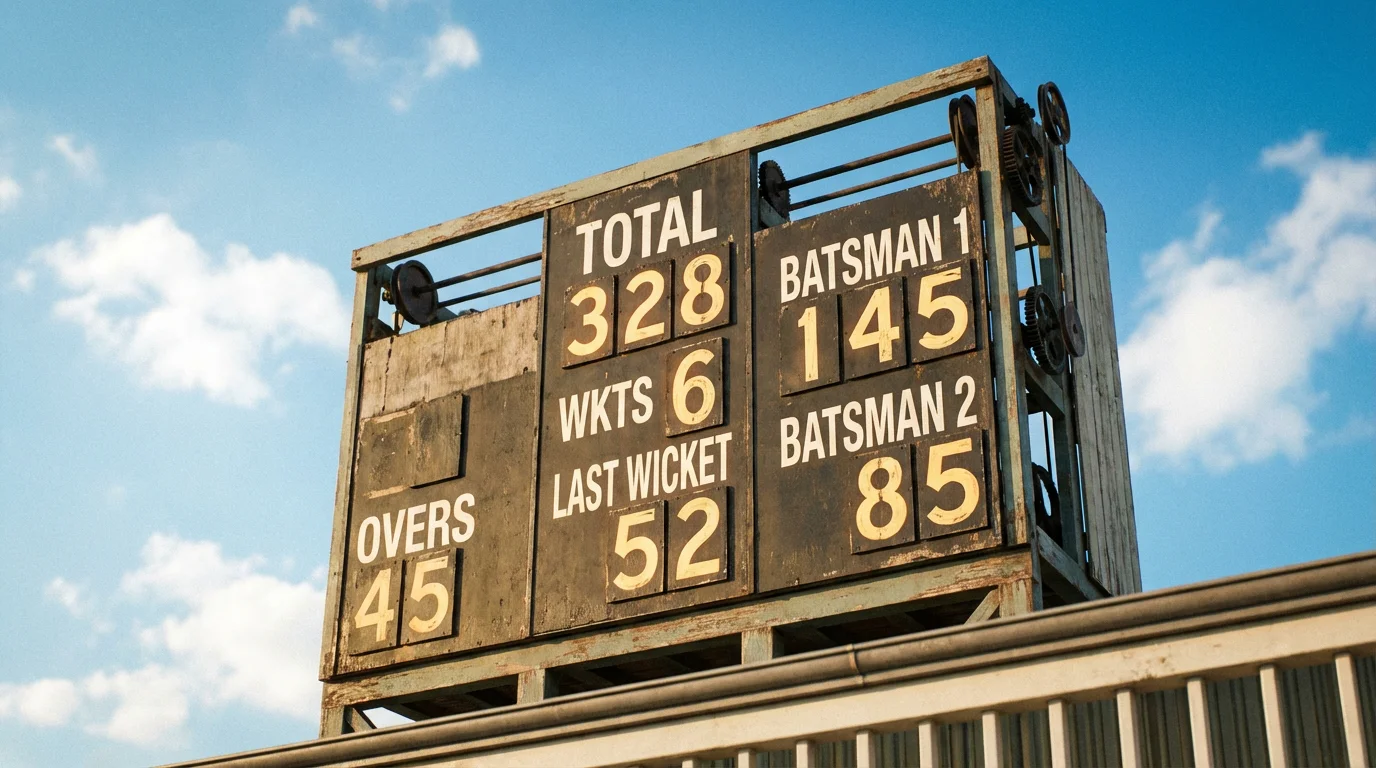
The totals market — betting on whether the runs scored in a match or innings will finish above or below a bookmaker’s set line — is one of the most popular markets in cricket betting for a reason that has nothing to do with excitement. It is popular because it works differently from almost every other market. You do not need to pick a winner. You do not need to predict individual performances. You need to assess a single, quantifiable outcome: how many runs will be scored. That simplicity, paired with the depth of analysis available for run-scoring patterns in cricket, makes the over/under market one of the most accessible and analytically rewarding bets in the sport.
The market exists in multiple forms. You can bet on the total match runs in a T20 or ODI, the first-innings total, the second-innings total, the powerplay total, runs in a specific over, or even runs in a particular batting partnership. Each variation has its own dynamics, but the core logic is the same: the bookmaker sets a line, you decide which side of it the actual outcome will fall on, and the .5 half-point ensures there is no tie.
This article covers how the line is set, what drives it, how to identify value on either side, and how the over/under market behaves differently across T20, ODI, and Test cricket.
See also boundaries market betting.
How the Line Is Set and What It Represents
The bookmaker’s line is a probability-weighted estimate of the expected total, adjusted to balance action on both sides. It is not the bookmaker’s prediction of the exact score — it is the number at which the bookmaker believes roughly equal amounts of money will be bet on the over and the under. This is a crucial distinction, because it means the line can be influenced by public perception and betting patterns, not just analytical fundamentals.
In a T20 match, the line for total match runs might be set at 325.5. This does not mean the bookmaker thinks exactly 326 runs will be scored. It means they believe 325.5 is the point where bettors will split roughly evenly. If the match is at a high-scoring venue and features two strong batting lineups, the public might lean toward the over, which could push the line higher than purely analytical models would suggest. This public-perception bias is one of the primary sources of value in the totals market.
The inputs that drive the line are well understood: venue scoring history, team batting and bowling strength, pitch conditions, weather, and time of day. Of these, venue history is the most heavily weighted. A ground that has averaged first-innings scores of 175 in recent T20 matches will anchor the line near that number, with adjustments for the specific teams playing. The other inputs refine the estimate, but the venue baseline does the heavy lifting.
Understanding this structure tells you where to look for value. If the line is anchored by a venue average that you believe is stale — perhaps the pitch has changed, or recent matches at the ground have trended significantly higher or lower — the bookmaker’s model is using outdated information. Your edge is in recognising the shift before the model catches up.
Identifying Value on the Over
Betting the over — predicting more runs than the line — is the more natural bet for most people. Fans enjoy high-scoring cricket, and the psychological bias toward action makes the over feel like the exciting side. This popularity means the over is often slightly overbet, which can create value on the under. But there are genuine situations where the over is the correct side.
The strongest over signals come from a combination of flat pitch, short boundaries, and weak bowling attacks. When all three align, run-scoring potential is maximised and the probability of exceeding the line increases. The key is to quantify “weak bowling.” A team’s overall bowling average is useful but can be misleading — what matters in the totals market is the bowling average in the specific format and at the specific venue type. A bowling attack that is effective on green surfaces in New Zealand may be toothless on flat tracks in India.
Another over signal is the dew factor in day-night matches. When heavy dew is expected in the second innings, bowlers lose their ability to execute slower balls and cutters, and run rates spike in the final third of the match. The bookmaker will adjust the line upward to account for dew, but the adjustment is not always sufficient. At venues where dew consistently adds 15-25 runs to second-innings totals, the over can offer persistent value in evening fixtures.
The trap to avoid on the over is what might be called “recency bias anchoring.” If the last three matches at a venue produced totals of 380, 395, and 370, the natural instinct is to bet the over on the next match. But those high totals may have been driven by specific team matchups or conditions that will not repeat. A fresh pitch, a different bowling attack, or overcast conditions can bring the total back to earth. Always check why recent totals were high, not just that they were high.
Identifying Value on the Under
The under is the contrarian side of the totals market, and contrarian positions in betting are often where the best value lives. Because casual bettors lean toward the over — they want to see big scores and they associate high totals with exciting cricket — the under tends to be slightly underbet relative to its true probability. This structural inefficiency is small but real, and over a large sample of bets it contributes to the under’s long-term profitability for disciplined bettors.
The clearest under signals come from conditions that suppress scoring: green pitches with seam movement, overcast skies that help swing bowling, and spin-friendly surfaces that slow the run rate. But conditions alone are not enough. You also need to assess the batting lineups for vulnerabilities. A team with a long tail — where the quality drops sharply after the top five — is more likely to undershoot the total than a team with deep batting that can recover from early wickets.
Bowling quality is the most underappreciated factor in under betting. A match featuring two of the best bowling attacks in the world will, on average, produce fewer runs than a match between two mediocre bowling units — even on the same pitch. This seems obvious, but the totals market does not always adjust fully for elite bowling. If two top-ranked bowling attacks meet on a surface with some assistance, the under is often the value side even when the venue’s historical averages suggest a higher total.
One specific under pattern that recurs in T20 cricket is the “first match of the tournament” effect. Opening fixtures at a venue, before the pitch has been used, often play differently than later matches. Fresh pitches in the subcontinent tend to be slower and lower-scoring than the prepared strips used later in the tournament. If the bookmaker sets the line based on the venue’s overall average without accounting for the fresh-pitch factor, the under can offer value in early-round matches.
Format Differences: How Totals Markets Vary
The over/under market operates in all three cricket formats, but the analytical approach changes significantly between them.
In T20 cricket, the market is fast-moving and volatile. Totals can swing dramatically within a few overs — a single big over of 20 runs shifts the trajectory entirely. The line for T20 matches is typically tight, with the bookmaker’s margin built into the odds rather than the line. This means the line itself is usually close to the “true” expected total, and value comes from finding the situations where conditions or matchups push the actual total away from that estimate.
In ODI cricket, the totals market is more stable and more predictable. Fifty overs of batting allow a larger sample of deliveries, which reduces variance. The line for ODI matches tends to be set higher — often in the 550-600 range for a full match — and the factors that drive it are more gradual: pitch wear over 100 overs, the impact of two new balls, and the pacing strategies teams employ across three distinct innings phases (overs 1-10, 11-40, and 41-50). For under betting in ODIs, the middle-overs squeeze is the key variable. If both teams have strong spin options and the pitch offers grip, run rates in overs 11-40 can drop substantially, pulling the total below the line.
In Test cricket, the totals market is fundamentally different. There is no fixed number of innings — a match can produce two, three, or four completed innings depending on declarations, follow-ons, and time. Some platforms offer a “first innings total” market, which is more analogous to the limited-overs version. Others offer match-aggregate totals, which are heavily influenced by how many innings are completed. For Test cricket totals, the pitch trajectory over five days is the dominant factor. A pitch that starts flat and deteriorates will produce a high first-innings total but potentially very low third and fourth-innings totals, making the match aggregate harder to predict than any single innings.
Live Totals: Where the Edge Sharpens
The over/under market comes alive during live betting, because the line updates with every ball and the information available to the bettor increases constantly. After the first innings of a T20 or ODI, you know exactly what one team scored, which removes half the uncertainty. The bookmaker then sets a second-innings line, and your job is to decide whether that line accurately reflects the conditions, the chasing team’s ability, and any changes in the pitch or weather.
The first-innings score is the most powerful piece of information for second-innings totals betting. If the first team posted 160 on a surface where 175 was expected, something is happening — the pitch is doing more than anticipated, the bowling is outstanding, or the batting team underperformed. Understanding which explanation is correct determines whether the second-innings total is likely to follow the same pattern or revert to the original expectation.
Totals Are a Mirror
The over/under market does not test your knowledge of teams or players. It tests your understanding of conditions — the pitch, the weather, the ground dimensions, the bowling quality, and the scoring dynamics of the specific format. It is a market that rewards the bettor who thinks in systems rather than narratives, who trusts data over instinct, and who recognises that the most profitable bets are often the ones that feel least exciting. The under on a grey day at Lord’s will never generate the same thrill as a last-ball six, but over a season of disciplined betting, it will generate something more useful: a positive return.
